
The Woman's Stone: Why Kunzite Is One of the Most Tender and Powerful Crystals You Will Ever Wear
Discovered in California at the turn of the twentieth century and embraced by Tiffany & Co. from its very first appearance, Kunzite has spent over a hundred years quietly earning one of the most devoted followings in the gemstone world. Here is why this extraordinary pink-purple stone deserves to be understood — and worn.
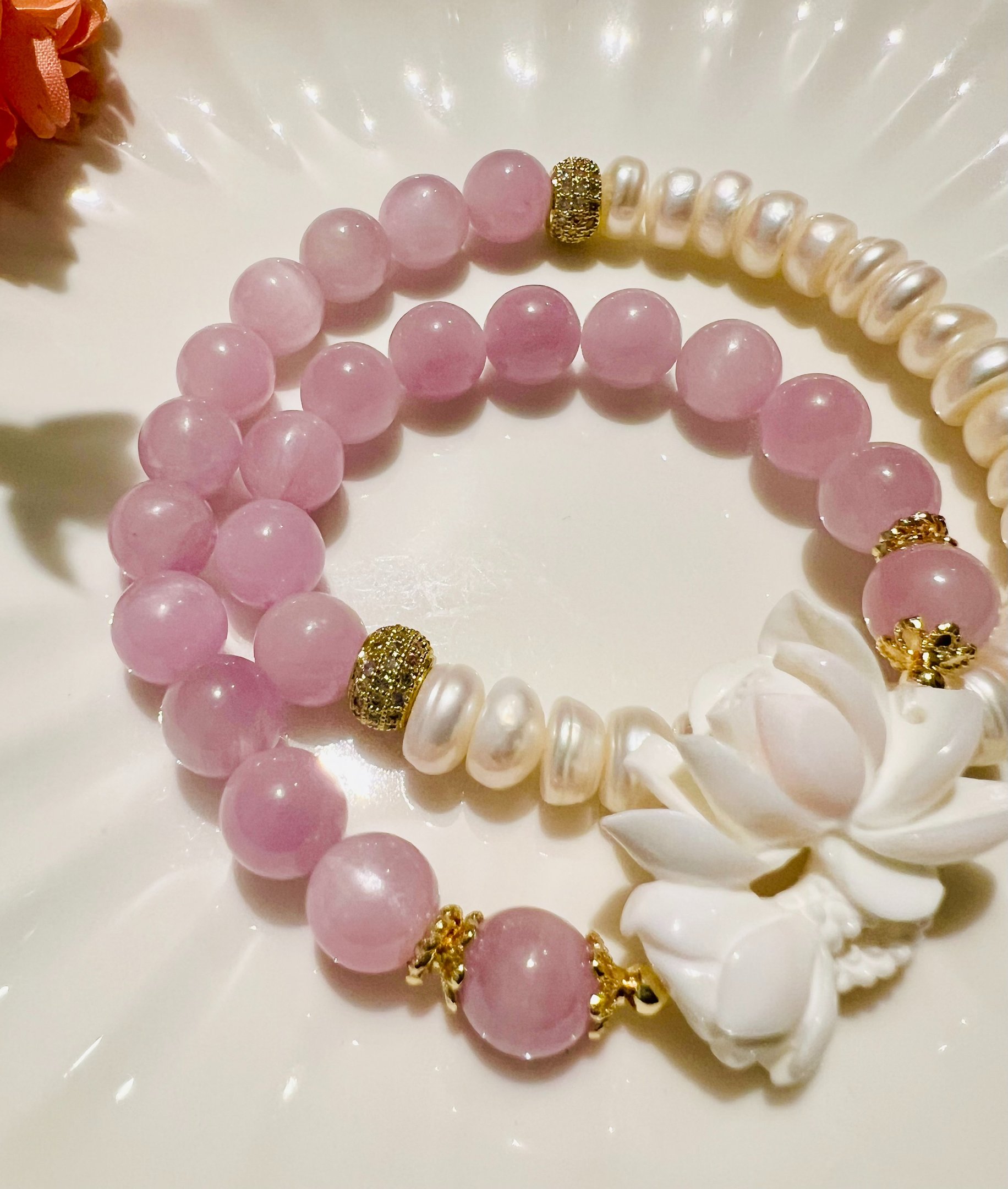
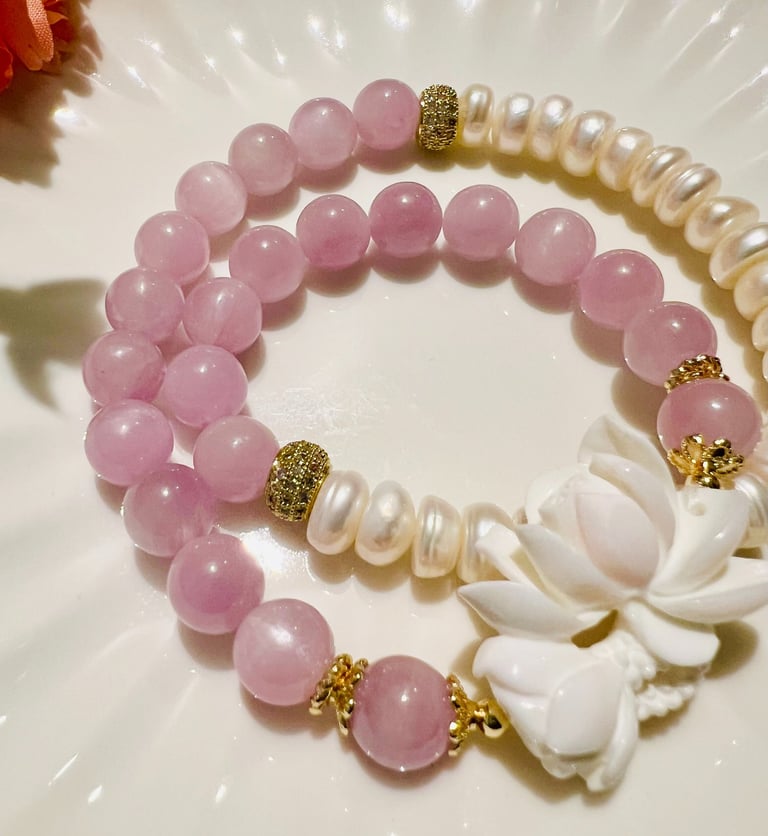
An American Stone With a Remarkable Beginning
Most gemstones have ancient discovery stories — found by civilizations whose names we barely remember, in places that have changed beyond recognition. Kunzite is different. Its story begins in 1902, in California, when George Frederick Kunz — chief jeweler at Tiffany & Co. and one of the most respected gemologists of his era — identified a captivating new variety of the mineral spodumene and brought it to the attention of the wider world. The stone was named in his honor, and it carries that name still.
It is one of the very few gemstones that can claim America as its birthplace, and there is something fitting about that origin. Kunzite arrived into the world not through ancient legend or royal treasure, but through the sharp eye of a jeweler who recognized something extraordinary in what he was looking at — and had the standing to ensure the world paid attention. From the moment of its discovery, it found its way into the hands of influential figures and elite collectors who were drawn to its unusual beauty and the qualities they sensed in it that went beyond the purely aesthetic.
What Kunz identified in that California stone was a gemstone of remarkable visual character — one whose colors ranged from the most delicate pale pink to a luminous light violet, shifting and changing in ways that few other stones could match. The gemstone world had not seen quite anything like it, and it has not forgotten it since.
A Color That Changes With the Light
What makes Kunzite visually unlike almost any other gemstone is a property called pleochroism — the ability to display different colors when viewed from different angles. Hold a fine piece of Kunzite in your hand and turn it slowly, and you will watch it shift from near-colorless to the palest blush to a deeper, more saturated pink or violet, depending on where the light catches it and the angle at which you are looking. It is not a trick of the imagination. It is a genuine optical phenomenon built into the stone's structure, and in a well-cut piece of Kunzite, it becomes something genuinely mesmerizing to watch.
The color itself is produced by the presence of manganese within the stone's composition — the same element responsible for the pink and violet tones found in other beloved gemstones. In Kunzite, it produces something particularly soft and luminous, a color that sits somewhere between the warmth of rose quartz and the cooler clarity of amethyst, while being entirely its own. Top-grade Kunzite is transparent, free from visible inclusions, and possesses a vividness that holds even in lower light — the kind of color that photographs beautifully but looks even better in person.
One note of care worth knowing: Kunzite responds to prolonged direct sunlight the way many of the finest things do — with gradual fading. It is a stone that appreciates being worn and admired rather than left in a sunny window. Store it in a soft cloth or padded compartment, clean it gently with mild soap and lukewarm water, and it will reward that care by remaining as luminous as the day you first put it on.
Why It Has Always Been Called The Woman's Stone
From early in its history, Kunzite earned a name that has stayed with it across more than a century: The Woman's Stone. It is a title that speaks not to exclusivity but to the particular qualities Kunzite is believed to carry — qualities of emotional depth, compassion, self-love, and the kind of quiet inner strength that sustains rather than performs.
Kunzite is consistently described as a stone of comfort. Those who wear it speak of a calming that comes not from suppressing emotion but from being held within it — a quality that makes difficult feelings easier to move through rather than around. In moments of emotional turmoil, Kunzite is said to act as a point of stillness, a reminder that the storm will pass and that the person within it has more resilience than they currently feel.
At a deeper level, Kunzite is believed to work on the patterns that keep people stuck — the loops of self-criticism, the habitual withholding of love from oneself, the emotional blockages that make genuine connection feel just out of reach. It encourages self-forgiveness with a gentleness that does not feel like weakness, and self-compassion with a warmth that does not feel like indulgence. Many people find that wearing it shifts something in how they relate to themselves — and that that shift, quietly and over time, begins to change how they relate to everyone else.
A Stone That Has Earned Its Following
Over a hundred years have passed since George Frederick Kunz first held that California stone and recognized what it was. In that time, Kunzite has moved from specialized collector circles to mainstream jewelry markets, from the curiosity of early twentieth century gemologists to the daily wrists and necks of people all over the world who simply know how it makes them feel.
That journey — from discovery to devotion — is the most honest kind of endorsement a stone can receive. Not a marketing campaign or a celebrity moment, but a century of people finding Kunzite, wearing it, and choosing not to take it off.
There is a reason The Woman's Stone has kept that name. It is not about who is allowed to wear it. It is about what it carries — tenderness, strength, the courage to love without armor, and the grace to extend that love inward first. Those are qualities that belong to everyone. And Kunzite, in its quiet and luminous way, offers them to anyone willing to receive them.
Follow us on our social channels at:
First order? Use code QUEEN10 for 10% off
Sign up for our newsletter! Get the inside scoop of our new arrivals and pop-up events.
Do you need any assistance? You can contact us at: cs@daintyxuan.com
© 2026 Daintyxuan. All Rights Reserved.