
The Real Thing: How to Spot Fake Queen Conch Jewelry — and Why It Matters
The Queen Conch takes over a decade to become something truly remarkable. That rarity is exactly what makes it a target for imitation. Here is what you need to know before you buy — and why authenticity, in this case, is everything.
When Something Is Rare, Imitation Follows
This is an old story. Whenever something is genuinely scarce and genuinely beautiful, the market finds ways to fill the gap with something that merely looks the part. The Queen Conch — scientifically known as Strombus gigas, found in the warm waters of the Caribbean, and requiring twelve to fourteen years of patient growth to reach gem-grade quality — is exactly the kind of material that attracts imitation. Its vibrant pink coloration, its smooth porcelain surface, its extraordinary rarity: all of these qualities make it deeply desirable, and desirability, when supply is limited, creates the conditions for counterfeits to thrive.
Understanding what fake Queen Conch looks like — and why authentic Queen Conch looks the way it does — is not just useful knowledge for a collector. It is essential for anyone who wants to wear something real.
What Imitation Actually Looks Like
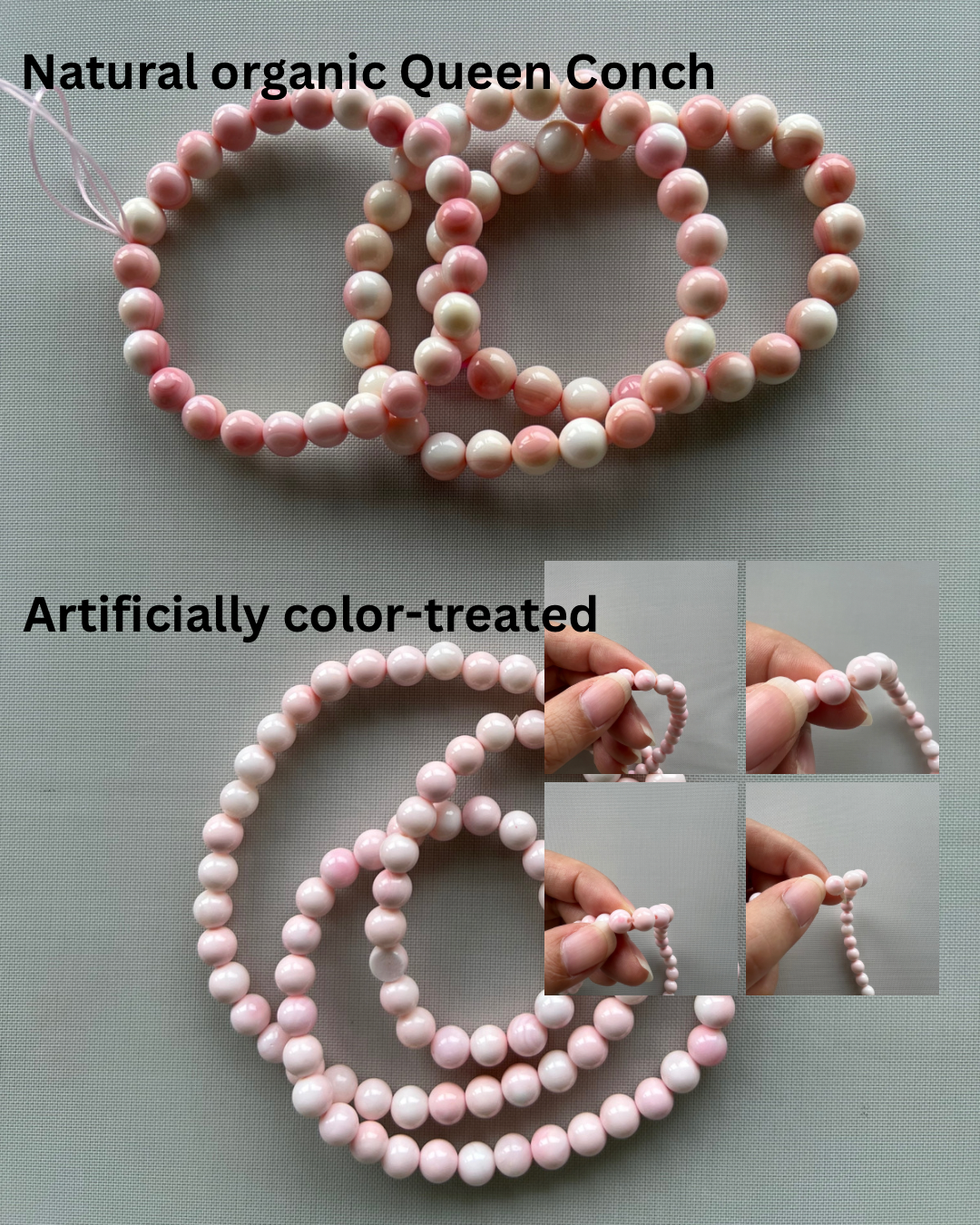
The most common form of fake Queen Conch jewelry involves artificially color-treated material. Pressed powder or color dye is applied to shells or shell fragments to replicate the distinctive pink hue that genuine Queen Conch develops naturally over years of growth. At a glance, and in certain lighting, these pieces can appear convincing. But they lack the quality that defines authentic Queen Conch: that natural, luminous radiance that comes not from a dye bath, but from over a decade of the ocean doing what only the ocean can do. The color in a treated piece sits on the surface. The color in a genuine Queen Conch lives within it.
Then there are the synthetic replicas — pieces made from resin or plastic, shaped and finished to mimic the appearance of a real shell. These are generally easier to identify once you know what to feel for, because the tactile difference between plastic and genuine shell is significant. Authentic Queen Conch has a coolness and density to it, a weight that synthetic materials simply cannot replicate. If you are ever genuinely uncertain and the stakes are high, heat applied carefully to an inconspicuous area will tell you quickly — plastic melts and releases a sharp, acrid smell. A genuine shell will do neither.
Five Things to Check Before You Buy
The good news is that genuine Queen Conch has qualities that are difficult to fake convincingly, and once you know what to look for, your eye for the real thing develops quickly.
The first thing to consider is price. Authentic Queen Conch jewelry is not inexpensive, and it cannot be — the rarity of gem-grade shells, the sustainability requirements around harvesting, and the craftsmanship involved in working with such a specific material all contribute to a price that reflects genuine value. If a piece is being offered at a price that feels surprisingly accessible, that is worth pausing over. Beautiful things that take twelve years to grow are not cheap to source.
Color is your next guide, and it is one of the most reliable. The pink of a genuine Queen Conch shell is partially shaded — it shifts and varies across the surface in ways that reflect the natural, uneven process of the shell's growth. It is not uniform. It is not flat. A dyed or treated piece, by contrast, tends toward an even, full saturation that looks almost too consistent. Nature does not produce that kind of regularity, and that evenness is the tell.
Texture speaks clearly too. Run your finger across an authentic Queen Conch surface and you will find something smooth, cool, and polished in a way that feels genuinely refined — like porcelain, but warmer in its origins. Counterfeit pieces often feel slightly rough, or carry an artificial sheen that sits differently under the light. The difference is subtle but real, and it becomes easier to feel the more you handle genuine material.
Weight is worth attending to as well. A gem-grade Queen Conch shell has spent years building density. It has substance in the hand — a quiet solidity that lighter synthetic pieces cannot match. If a piece feels unexpectedly light for its size, that is information worth taking seriously.
And finally — a note on certificates. It may seem reassuring to be offered documentation of authenticity, and in some contexts, certification matters. But in the Queen Conch market specifically, paper certifications have become something of a red flag rather than a guarantee. Fake certificates are, unfortunately, not difficult to produce, and counterfeit Queen Conch jewelry has developed a curious habit of arriving with impressive-looking paperwork. Do not let a certificate be your primary source of confidence. Let the piece itself speak — its color, its weight, its texture, its price — and trust what those things tell you.
All of Its Colors Are a Gift
One thing worth saying clearly: genuine Queen Conch does not always present as the bright, vivid pink that most people picture. Natural Queen Conch shells come in a range of colors — pink, gold, and white among them — each one the result of the particular conditions of that shell's growth and the waters it came from. None of these colors is lesser than another. They are all expressions of the same remarkable process, and they all carry the same authenticity.
We believe that the most beautiful thing about the Queen Conch is precisely its naturalness — the fact that no two pieces are ever identical, that the color cannot be engineered, that the beauty you see is the beauty the ocean produced. That is not something that can be printed on a certificate. It is something you feel when you hold the real thing in your hand.
At Daintyxuan, every Queen Conch piece we work with is 100% natural. We do not use artificially color-treated shells, and we do not compromise on that — because the whole point of wearing something this rare is that it is genuinely what it appears to be.
Authenticity is not just a quality standard. For a gemstone this extraordinary, it is the entire story.
Follow us on our social channels at:
First order? Use code QUEEN10 for 10% off
Sign up for our newsletter! Get the inside scoop of our new arrivals and pop-up events.
Do you need any assistance? You can contact us at: cs@daintyxuan.com
© 2026 Daintyxuan. All Rights Reserved.