
The Rarest Gift of the Caribbean: Why the Queen Conch Is Among the Finest Gemstones on Earth
Not every gemstone is born from the earth. Some are born from the sea — slowly, quietly, and against extraordinary odds. The Queen Conch is one of nature's most remarkable creations, and once you understand what it takes to produce a single gem-grade shell, you will never look at it the same way again.
A Life Lived Against the Odds
The Queen Conch begins its life as something fragile and unremarkable — a small marine snail making its way through the warm, clear waters of the Caribbean Sea. Most conch shells never get the chance to become anything more than that. They are harvested young for food, or they fall prey to sharks, fish, and eagle rays that patrol the same waters. At this early stage, between three and four years old, the shell is small, brittle, and colorless. A strong hand could break it with little effort. These young shells may occasionally produce a conch pearl, but they carry none of the beauty or substance that defines the Queen Conch at its finest.
Survive a little longer — reach around eight years — and something begins to change. The shell grows larger and starts to show the first flush of the pink coloration that collectors and craftspeople have prized for generations. It is a hint of what is coming, a promise not yet fully kept. The shell is still too fragile to work with, still too thin to hold the kind of carving that would do it justice. But the direction is clear. Something extraordinary is forming.
Twelve to Fourteen Years in the Making
Here is where the story becomes something worth telling.
A Queen Conch that survives to between twelve and fourteen years old is, in every sense of the word, exceptional. The Caribbean is not a forgiving environment for a creature that moves slowly and carries its home on its back. To reach this age is to have navigated years of predators, human harvesting, and the quiet difficulty of simply surviving. Finding one of these shells is, as we genuinely believe, a miraculous gift of the Caribbean — one that cannot be engineered, rushed, or replicated.
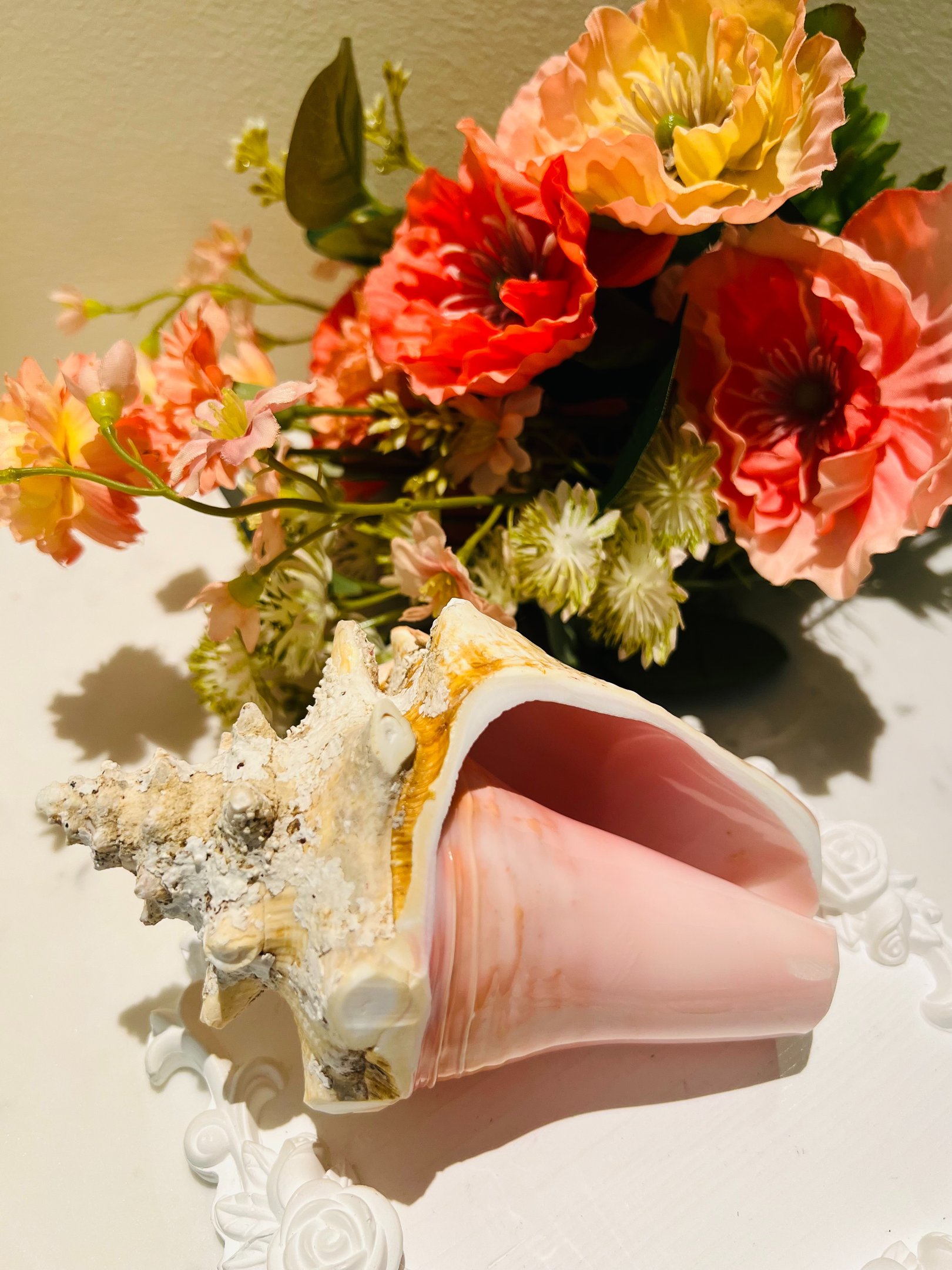
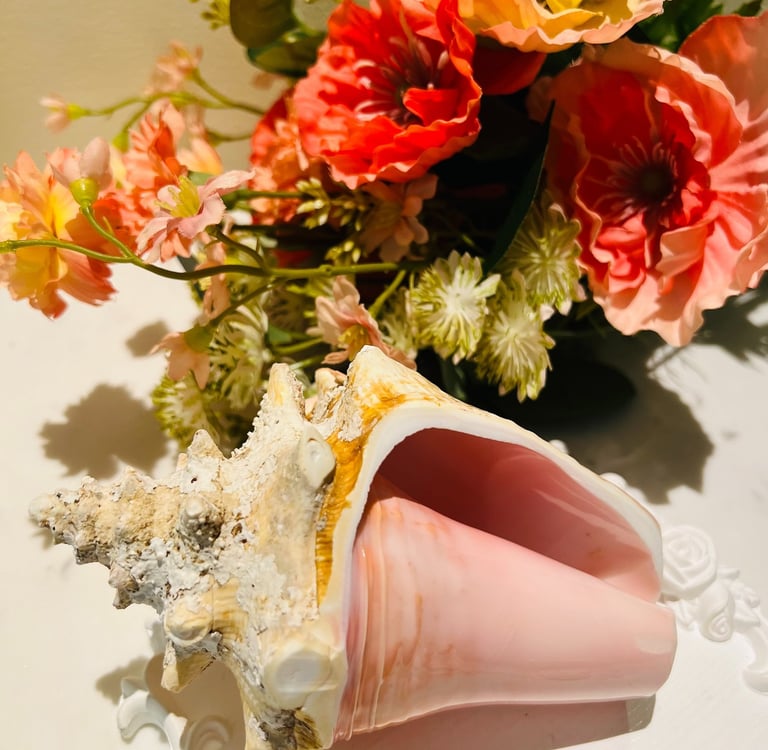
When you encounter a shell of this age, you know it immediately. The pink of the interior is no longer a suggestion — it is vivid, saturated, and extends all the way to the lip of the shell in a way that younger specimens simply cannot achieve. The shell itself has grown noticeably thicker, denser, and more substantial in the hand. It has weight. It has presence. And it is now — only now, after more than a decade of growth — ready to be worked into the gem-grade pieces that make Queen Conch jewelry so remarkable.
That timeline is worth sitting with. The diamonds in a ring. The gold in a chain. These things are extracted and refined over days or weeks. A gem-quality Queen Conch shell takes twelve to fourteen years just to become workable. There is no shortcut to that. There is no factory that can produce it. There is only time, and the sea, and the unlikely fortune of survival.
A Tradition That Stretches Back Centuries
The Queen Conch is not a recent discovery. As far back as the Victorian era, its shells were already being treasured for the extraordinary cameos and decorative sculptures that skilled artisans could coax from them. The art of engraving and carving into the shell's surface — revealing the layers of color beneath, creating imagery of breathtaking delicacy — is a tradition that stretches back to ancient times. Civilizations that never shared a language or a continent both arrived, independently, at the same conclusion: that this shell was something worth the effort of transformation.
The reason is not difficult to understand. The Queen Conch offers an artisan something that almost no other natural material can — a surface that is simultaneously hard and smooth, richly colored and naturally varied, capable of holding the finest detail without fracturing under the blade. Cameos carved from Queen Conch have a warmth and depth that those cut from synthetic materials cannot approach. Each piece carries the natural variation of the shell itself, which means that no two carvings, no matter how similar the design, will ever look exactly alike.
What It Feels Like to Wear It
There is something that photographs of Queen Conch jewelry cannot fully convey, and that is the experience of wearing it.
The surface of a gem-grade Queen Conch shell is smooth — genuinely, luxuriously smooth — and cooling against the skin in a way that is immediately noticeable and consistently pleasant. The closest comparison most people reach for is porcelain: that same refined, almost glassy quality that feels elevated and intentional. But unlike porcelain, the Queen Conch is exceptionally durable. It does not carry the brittleness of its early years. A mature, gem-grade shell has spent over a decade building density and strength, and it shows.
And then there is the color. The pink of a Queen Conch is not the pastel pink of something man-made. It is natural, alive, and deeply varied — moving from the softest blush at the edges to deeper, richer tones at the core, shifting subtly depending on the light and the angle at which you hold it. It is the kind of color that draws the eye and holds it. The kind that prompts people across a room to ask what it is you are wearing.
Rarity That Means Something
In a world where almost everything can be mass-produced, there is something quietly profound about a material that simply cannot be. No manufacturer can grow a Queen Conch faster. No process can substitute for the years of slow, patient development that produce a gem-grade shell. The rarity of the Queen Conch is not a marketing claim — it is the biological reality of a creature that takes over a decade to reach its potential, in waters that offer no guarantees.
When you wear a piece of Queen Conch jewelry, you are wearing something that began its life long before it ever became an object of beauty. You are wearing the Caribbean Sea, and the years it took, and the extraordinary unlikelihood of a shell that survived long enough to become what it was always meant to be.
That is not something you can say about many things you will ever own.
Follow us on our social channels at:
First order? Use code QUEEN10 for 10% off
Sign up for our newsletter! Get the inside scoop of our new arrivals and pop-up events.
Do you need any assistance? You can contact us at: cs@daintyxuan.com
© 2026 Daintyxuan. All Rights Reserved.