
More Than a Stone: Why Jade Has Been the World's Most Revered Gemstone for Centuries
From the wrists of ancient emperors to the vanity tables of modern beauty rituals, jade has endured as something far more than decorative. It is a stone that carries meaning, memory, and a quiet power that generations have trusted with their lives — and their legacies.
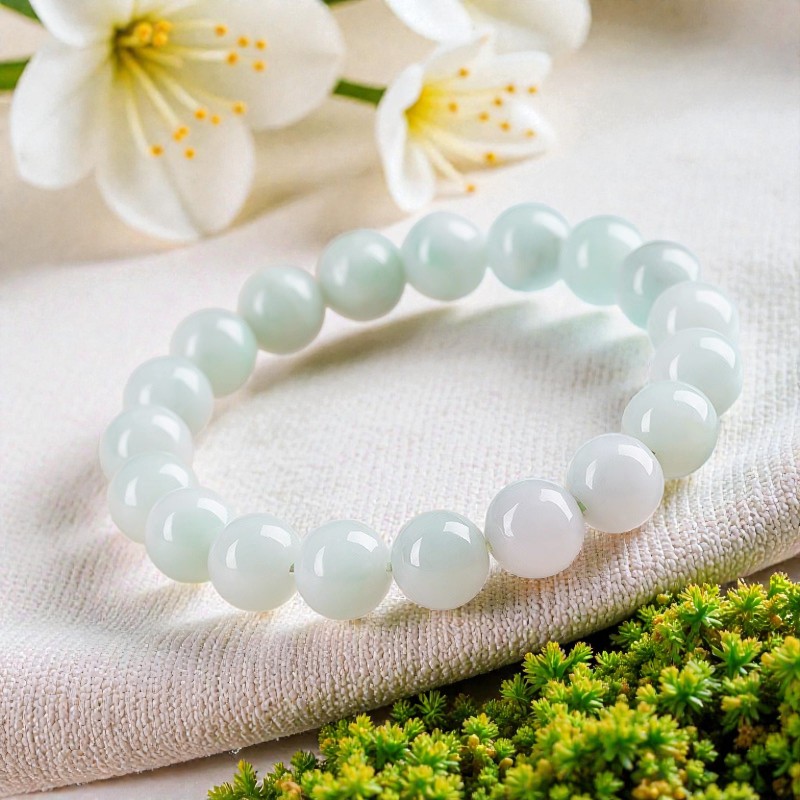
A Stone That Has Always Meant Something
There are gemstones that are beautiful, and there are gemstones that are believed. Jade belongs to the second category — and has for longer than almost any other stone in human history.
Ancient civilizations across the world arrived at jade independently and came to remarkably similar conclusions about it. It was rare. It was unique. It carried something that other materials did not. The elite wore it. Royal families treasured it. Warriors carried it into battle and buried it with their dead. Across cultures that shared no language, no trade route, and no common tradition, jade occupied the same elevated position: not merely as an ornament, but as an object of genuine power.
That is not a coincidence. That is a pattern worth paying attention to.
What Jade Means in Chinese Culture
Nowhere has jade been more deeply understood — or more completely woven into the fabric of daily life — than in Chinese culture. In China, jade is not simply a gemstone. It is a philosophy. It represents purity, grace, and immortality. It is believed to bring harmony and balance to the wearer, attracting good fortune while quietly standing guard against negative energy. To give someone jade is to give them something that wishes them well in the most serious possible sense.
The relationship between a person and their jade is considered deeply personal, and it deepens over time. A jade bangle worn tight against the wrist — as tradition holds it should be, both to minimize wear and to stimulate the acupuncture points beneath — becomes energized through daily contact with its wearer. The stone and the person attune to one another. What begins as an object becomes, over years and decades, something closer to a companion.
The first jade I ever encountered was the bangle my grandmother wore. She had put it on before her wedding and never taken it off. It stayed on her wrist through every season of her life, through every difficulty and every joy, until she passed. There was nothing passive about the way she wore it. It was a commitment — to the stone, and to everything it represented. I have never forgotten what that looked like, and I have never stopped thinking about what it meant.
What Jade Offers the Person Who Wears It
Jade is consistently described, across traditions and centuries, as a stone of calm. It carries a soothing quality that works on both the mind and the body — quieting anxiety, softening fear, and creating the kind of interior steadiness that allows clearer thought and more grounded emotion. Many people turn to jade specifically during periods of stress or uncertainty, finding in its cool, smooth surface a quality that mirrors what they are reaching for internally.
Beyond its calming presence, jade is associated with wisdom and creative clarity. It is said to stimulate intuition and sharpen the kind of thinking that leads to genuine insight — which may explain why artists and writers have long been drawn to it. There is something about jade that feels conducive to depth, to patience, to the long view.
Physically, jade has been valued in traditional Chinese medicine for its cooling properties — its ability to help regulate body temperature and support circulation. It has been used to address headaches, joint discomfort, and digestive concerns, and its cooling quality against the skin is not merely sensory. For those who subscribe to its therapeutic tradition, the physical benefits of jade are as real and as considered as the emotional ones.
Two Jades, Each With Its Own Character
Not all jade is the same, and the distinction is worth understanding. There are two main varieties — nephrite and jadeite — and each carries its own qualities and character.
Jadeite is the rarer of the two, more intensely colored and generally more valuable. Its vivid greens, deep lavenders, and rich imperial tones have made it the stone of choice for high-end jewelry for centuries. When people speak of the most prized jade in the world, they are almost always speaking of jadeite.
Nephrite is softer in its palette and subtler in its appearance, but it carries its own devoted following. Many artists and craftspeople prefer nephrite precisely because of its quieter, more complex visual character — the way its colors shift and deepen, the particular quality of its surface. Neither is lesser than the other. They are simply different expressions of the same extraordinary material, and the right choice is the one that speaks to you.
Jade in the Modern Ritual of Beauty
In recent years, jade has found a new and flourishing role in the world of beauty and skincare — and it turns out the same qualities that made it treasured for millennia translate remarkably well into the contemporary vanity.
Jade facial rollers have become one of the most widely adopted tools in modern skincare, used to massage the face and neck in a way that promotes lymphatic drainage, reduces puffiness, and improves circulation. The natural coolness of the jade soothes and calms the skin, while the motion of the rolling stimulates collagen production and brings a visible brightness that devotees find genuinely transformative. It is an old material doing something new, and doing it beautifully.
Gua sha tools carved from jade take the tradition further still. The technique — drawing the stone gently across the skin to encourage circulation and release muscular tension — has been practiced in Chinese medicine for centuries and has now found a global audience drawn to its results. Fine lines soften. The complexion lifts. The ritual itself, unhurried and deliberate, becomes a form of care that extends beyond the surface.
What strikes us about jade's presence in modern beauty is how naturally it belongs there. The same cooling properties, the same calming energy, the same deep attunement to the body's wellbeing — these are not new discoveries. They are ancient understandings, rediscovered by a generation that is learning, slowly, to trust what has always worked.
A Stone That Earns Its Place
Jade does not ask to be understood all at once. It reveals itself over time — through the way it feels against the skin, through the calm it seems to carry into a room, through the stories that accumulate around it across a lifetime of wearing it.
My grandmother's bangle never left her wrist. I used to wonder, as a child, what she thought it was doing for her. Now I think I understand. It was not simply jewelry. It was a relationship — with the stone, with the tradition it embodied, with everything she believed about the kind of life worth living.
That is what the finest gemstones do. They hold more than beauty. They hold meaning — and meaning, unlike fashion, does not age.
Our jade pieces are selected for the depth and integrity of the stone. If jade has been on your mind, it may already be calling. Explore our Love + Jade collection and find the piece that was always going to be yours.
Follow us on our social channels at:
First order? Use code QUEEN10 for 10% off
Sign up for our newsletter! Get the inside scoop of our new arrivals and pop-up events.
Do you need any assistance? You can contact us at: cs@daintyxuan.com
© 2026 Daintyxuan. All Rights Reserved.